
CERN and AI Federated Learning
Artificial intelligence (AI) is carving out new routes to scientific discoveries at pace and for over four decades, CERN has been using AI in its work. Today at CERN, AI is being integrated into data processing, event simulations and numerous other processes. These technologies can also make an impact in the world outside the Laboratory.
CAFEIN – one of CERN AI technologies
The Large Hadron Collider (LHC) at CERN generates significant amounts of data that are routinely transferred to be centrally stored and processed by machine learning algorithms. A challenge is to minimize data transfers and central storage to enhance efficiency, reinforce privacy and reduce associated carbon emissions. These factors are also of paramount importance in the handling of private and personal healthcare data.
CAFEIN is a CERN-developed Federated Learning (FL) AI platform designed for flexible, scalable, and privacy-preserving workflows. Originally designed to support predictive maintenance and anomaly detection in CERN’s particle accelerator systems, CAFEIN has evolved into a production-grade, privacy-preserving AI infrastructure. Today, it empowers research, healthcare and industry partners to co-develop trustworthy AI models while ensuring that sensitive or proprietary data never leaves its source.
CAFEIN offers promise as a healthcare data solution tool by enabling the training of several local AI models without the need to transfer confidential source data, but instead the AI model parameters. At the end of the training and without any local data exchange, a finalized global model aggregating all local AI models is established and shared.
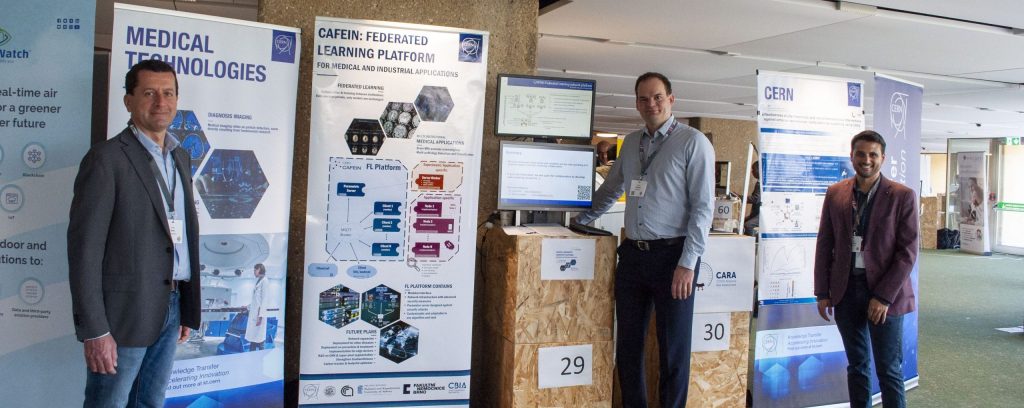
CAFEIN has found impactful applications, such as supporting global supply chain resilience with the World Health Organization (WHO), enabling cancer risk prediction models with the International Agency for Research on Cancer (IARC) and powering privacy-preserving diagnostics and prognostics for brain pathologies in hospital environments.
In 2025, the CAFEIN project won the Innovate for Impact in Healthcare Award at the AI for Good Summit for its application to the TRUSTroke and UMBRELLA projects.
Partnering to use CERN AI expertise for stroke treatment and prevention
The EU-funded TRUSTroke project offers a set of tools for the reliable prediction of stroke recurrence in patients. The risk of stroke recurrence is high (as much as 25%) and being able to reliably predict a potential recurrent stroke would help to better define a patients’ rehabilitation process and to optimize their engagement with it. TRUSTroke tools support healthcare professionals with making the right decisions to improve the delivery of care and, ultimately, patient outcomes.
The project is based on the training of novel AI tools which are then deployed and fully integrated into stroke care workflows. This enables medical professionals to examine the actions performed by patients and to personalise risk prediction of early readmission, stroke recurrence and predict long-term clinical outcome.
CERN manages the federated learning platform used in the project to create the needed AI models and deploys its Graph Neural Network models derived from complex systems modelling. The development is focused on improving and expanding the functionalities of the CAFEIN platform, with a focus on software security and machine learning privacy.
UMBRELLA – addressing the entire stroke pathway
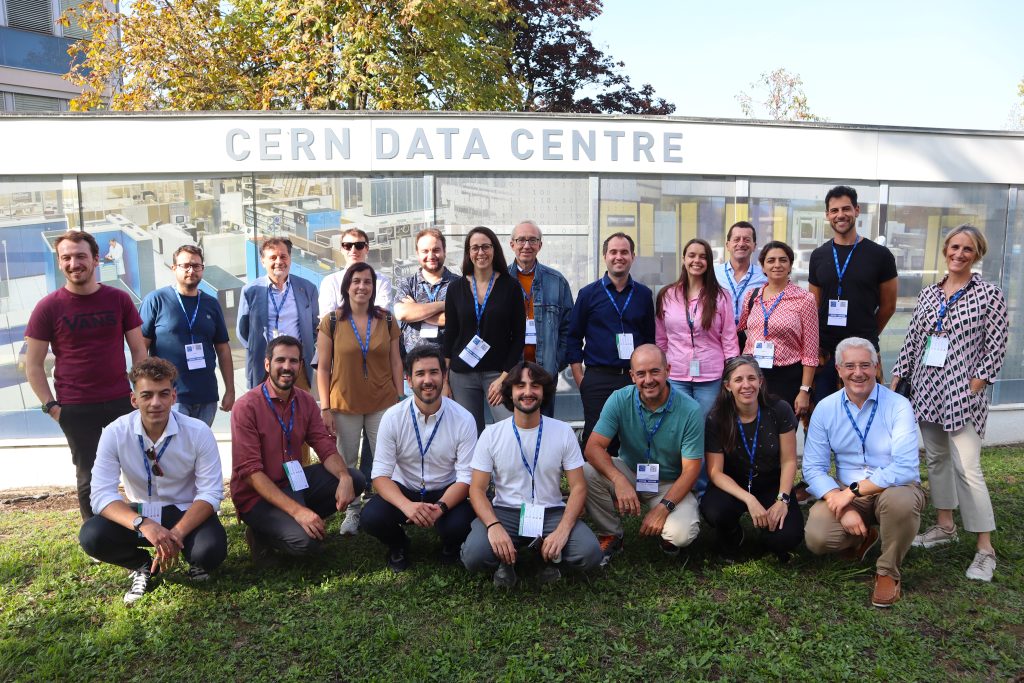
UMBRELLA (Unleashing a CoMprehensive, Holistic and Patient Centric Stroke Management for a Better, Rapid, AdvancEd and PersonaLised Stroke Diagnosis, TreAtment and Outcome Prediction) is a consortium of over twenty public and private partners that aims to revolutionize the entire stroke care pathway in Europe. The EU-funded project was launched in 2024 and will run until 2029.
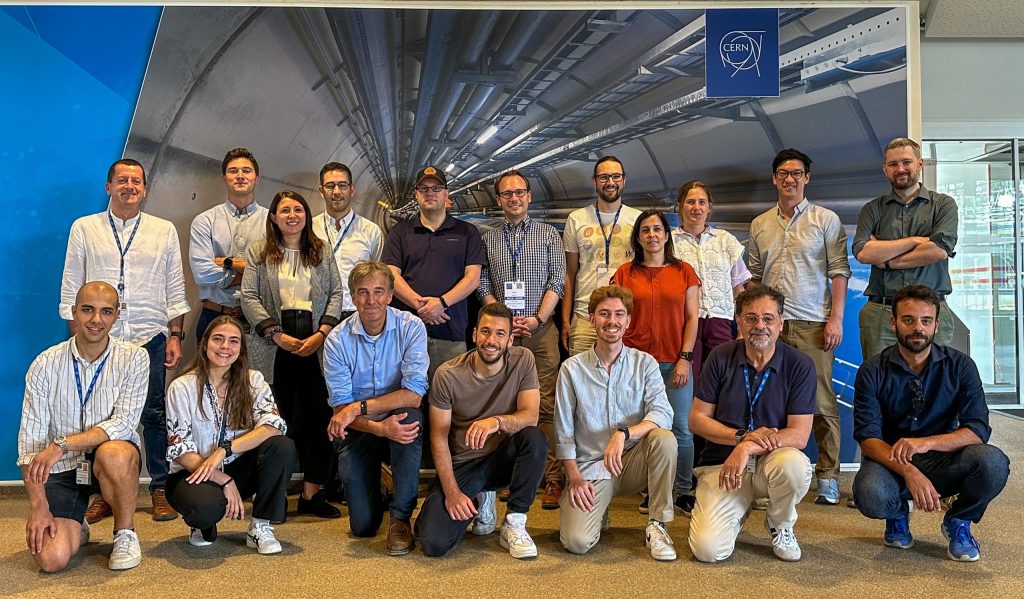
UMBRELLA complements the work being carried out under TRUSTroke, focusing on the implementation of a comprehensive approach that addresses gaps along the whole stroke care pathway, from diagnosis and emergency treatment, right through to rehabilitation and prevention of recurrent strokes. Furthermore, the project extends the capabilities of the CAFEIN platform to multimodal data analysis.
The project gathers data from across the whole stroke continuum to build and implement a real-world federated data platform (U-Platform) for making available interoperable, harmonised, anonymised and standardised real-world stroke data, protocols, programmes, and information. The U-platform will enable the development and training of AI innovative tools through a novel Federated Learning infrastructure (FL-platform) that preserves data privacy and sovereignty.
CERN provides the design, development, deployment and operation of the UMBRELLA FL-Platform based on CAFEIN. Furthermore, CERN partners with SIEMENS to provide the core system of the FL-Platform to the SIEMENS Healthineers Teamplay digital platform. Healthineers Teamplay is extensively deployed across institutions and hospitals for local data management and analysis thus extending SIEMENS capabilities in UMBRELLA to global analysis via CERN CAFEIN FL.
CERN AI Federated Learning research in 2025
In 2025, CERN published a paper that proposed a novel carbon tracking framework that allows reporting the energy/carbon expenditure of FL processes over wireless networks.
Numerical results show that up to 80% energy savings are possible when carefully selecting the specific FL algorithm and the compression parameters.
CERN also published a conference paper on Differential Privacy, a method that offers rigorous, quantifiable guarantees against inference attacks to FL environments, important for healthcare settings.
The landscape of AI has evolved from single AI models to networks of specialized agents that can decompose tasks, maintain persistent context, and coordinate their efforts through structured communication towards a common goal. To address the coordination complexity that this brings, in 2025 CERN published a paper that introduced Federation of Agents, a semantics-aware communication fabric that transforms agent coordination through orchestration, from static to dynamic.
CERN technical contact: Luigi Serio.