
CERN and Airbus UpNext expand collaboration
In 2025, the partnership entered a new phase with the launch of the two-year SAMBA (Superconducting Applied Materials for Broadband Aircraft Vibrations) project that will build on a first-phase collaboration called SCALE (Super-Conductors for Aviation with Low Emissions).
CERN and Airbus UpNext are exploring the potential of hydrogen-powered aircraft with the ultimate aim of reducing the emissions associated with the aviation sector.
The collaboration stems from joint efforts to integrate high-temperature superconducting (HTS) technology – which CERN has considerable expertise in due to its use in particle accelerators – into the design of a hydrogen-powered aircraft.
While SCALE developed a demonstrator that contributed to showing the feasibility of the concept, SAMBA focuses on the optimisation, manufacturing and testing of lightweight, high-temperature superconducting (HTS) cables for a transmission line. Work is being done on the validation of the new HTS technology under vibrating conditions matching those found in an aircraft.
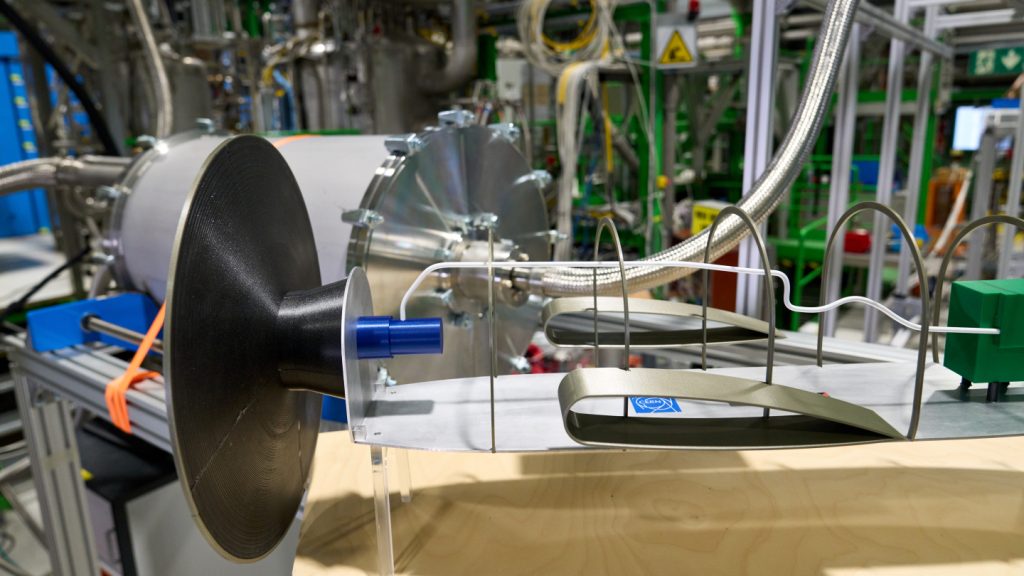
The partnership brings together CERN’s expertise in superconducting technologies, including design and testing, with Airbus UpNext’s background in airplane design and integrating superconductive components into propulsion systems.
Amalia Ballarino, Head of CERN’s High Temperature Superconductors and Devices Section, said:
“Scaling up electric propulsion to larger aircraft is a major challenge. Superconducting technologies are a promising solution as they enable higher specific power in the electrical distribution system while significantly reducing its mass. SCALE and SAMBA, which use the HL-LHC Superconducting Link technology to support the development of an aircraft power transmission line, demonstrate how accelerator technologies are a key driver of innovation and can also have a wider impact on society.”
The SCALE demonstrator
In a hydrogen-powered aircraft, the transmission line refers to the series of components that connect the fuel cells, which generate electrical energy, to the propulsion system.
SCALE, which ran from 2022 to 2024, resulted in the successful design and assembly of a seven-metre-long flexible transmission system demonstrator at CERN, made to fit within a future hydrogen-powered plane. A test bench for the cryogenic cooling and the powering of the demonstrator was also constructed.
The demonstrator designed and constructed at CERN was made to fit the requirements of Airbus UpNext’s own powertrain demonstrator, ASCEND.
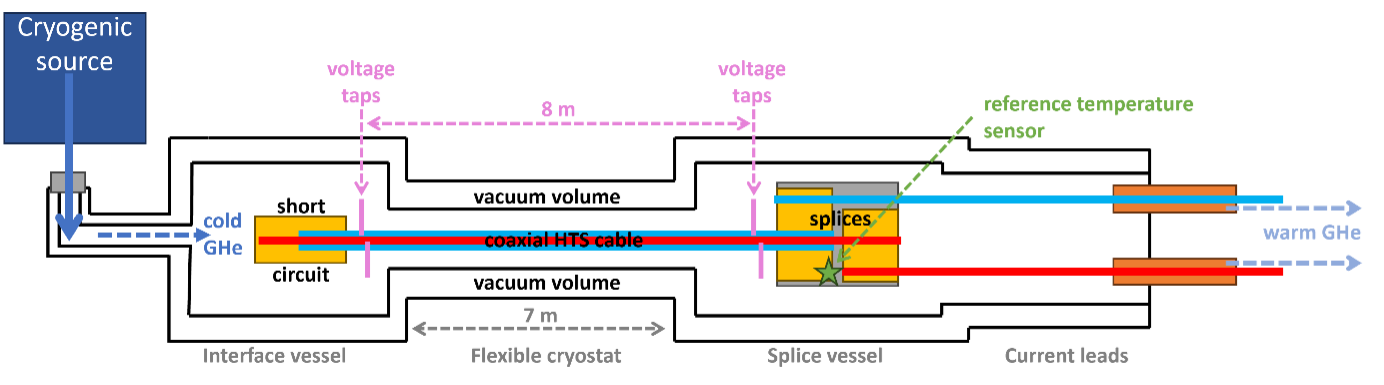
The test phase included checking the demonstrator’s operating functionality in DC mode within a certain temperature range, carrying out a series of high-voltage insulation tests, and checking that the electrical splices – or connecting joints – were stable and showed low resistance. The tests performed at CERN successfully validated stable DC operation at ±2 kA at up to 63 K. The weight of the ±2 kA HTS REBCO coaxial cables was about 290 g/m.
The SCALE transmission line used a material made from Rare-Earth Barium Copper Oxide, commonly known as REBCO. REBCO is considered a highly promising superconducting material for use in hydrogen-powered planes because of a combination of properties – its high operating temperature, current capacity, field tolerance, mechanical strength, and the fact that it requires simpler cryogenic cooling systems.
CERN uses this material for the Cold Powering of HL-LHC magnets, where REBCO is the extension of the Superconducting Links, and studies it for the FCC-hh project, to make future accelerators more efficient and more sustainable. The collaboration with Airbus UpNext capitalizes on years of developments in this direction.
SAMBA and the future
The second stage of CERN and Airbus UpNext’s partnership, called SAMBA, directly builds on the work carried out to build the SCALE demonstrator.
This phase of collaboration, which will be completed by the end of 2026, aims to develop, manufacture and fully characterize at CERN, HTS REBCO cables that can be used in Airbus UpNext’s new technical demonstrator, called Cryoprop. While the SCALE demonstrator proved the viability of the technology, SAMBA aims to optimise it.
The work will include vibration testing of the cables to ensure that they are suitable for an environment similar to those found on a hydrogen-powered plane.
CERN technical contacts: Amalia Ballarino and Christian Barth.