
Testing of electronic equipment for use in space at CERN’s HEARTS facility
Galactic Cosmic Rays and radiation from Solar Particle Events are ionising radiation composed of very energetic atomic nuclei (ions) which pose major risks to both spacecraft electronics and human health during long missions. Their interaction with electronic components can trigger failures that could threaten mission success. Many future space applications such as big data analysis or in-orbit use of artificial intelligence will be dependent on the use of advanced microelectronic components for space missions, telecommunications and Earth observation.
The application of new technologies and high-performance electronics components in the space industry is rapidly increasing. The increasing complexity of these technologies requires innovative solutions to test their capability to tolerate the harsh radiation environments where they will operate, limiting the risk of failure and supporting space sustainability. Suitable testing facilities are hard to find, and considerable effort is being invested to secure their strategic availability in Europe.
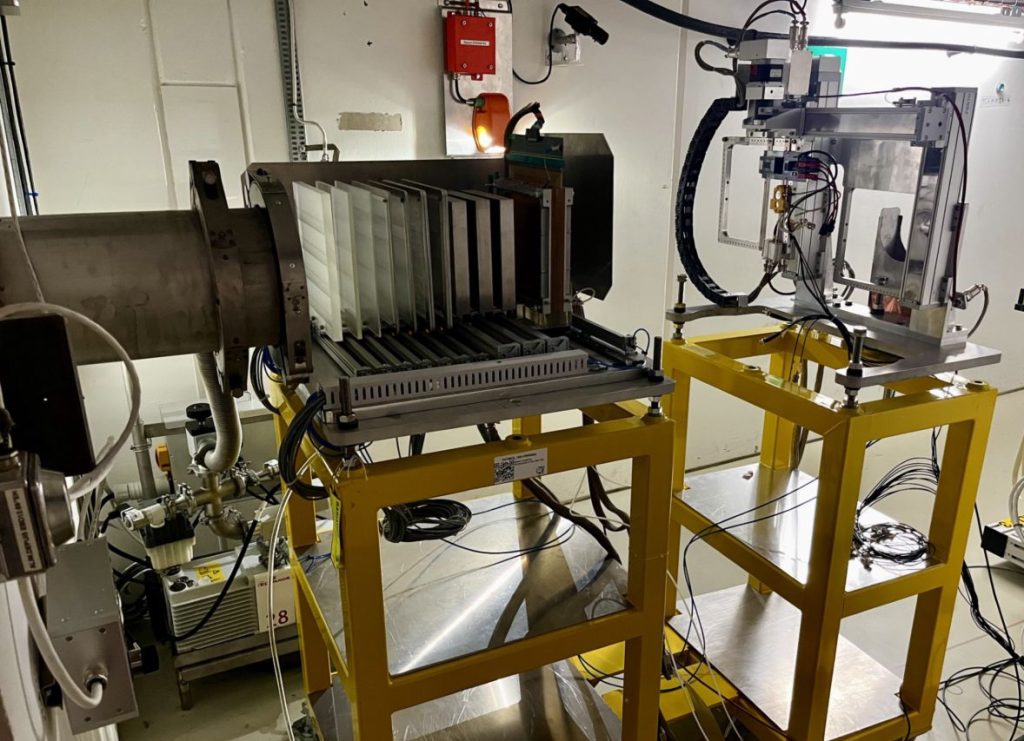
CERN is developing its offer at the HEARTS@CERN facility to support innovative aerospace organisations, including startups, needing high quality beams to carry out such testing. The HEARTS facility offers industrial and research users access to CERN facilities as they strive to secure European access to space. HEARTS started operations in 2023 and has already completed two full user runs in 2024 and 2025.
Thanks to the HEARTS EU project, electronic devices can be tested at CERN in conditions that simulate cosmic radiation environments. The combination of high Linear Energy Transfer values and large penetration depth means that the beams at HEARTS are ideal for users wishing to qualify advanced packaging structures avoiding complex decapsulation processes. Using CERN’s facilities, companies and research institutes have access to high-energy heavy ion beams (>100 MeV/n) for testing advanced electronic devices to ensure their suitability for not only space use but also for use in particle accelerator and detector radiation environments.
During the second HEARTS radiation testing campaign held in November and December 2025, 16 companies and research institutes conducted over 200 irradiation hours of testing on electronic components and modules for a variety of uses in space and high energy physics applications.
It was the first time that CERN published an open call and subsequently selected proposals to allow industrial access to the HEARTS@CERN facility. 13 applications were approved for access to HEARTS, seven of which received beamtime through their association with the project or via the RADNEXT project.
For example, in 2025, critical components of Printed Circuit Boards that will be used in the design of the Ramses CubeSat 1 (RCS 1) were tested at CERN’s IRRAD facility by Tyvak International, a world leading manufacturer of nano and microsatellites and member of the consortium involved in the development of Hera’s Milani previous mission of asteroid deflection.
RCS-1 will be part of Rapid Apophis Mission for Space Safety (Ramses), a collaboration between ESA, JAXA and NASA. This planetary defence mission, will rendez-vous with the asteroid Apophis and accompany it through its exceptionally close flyby of Earth in 2029.
As another example, Seibersdorf Laboratories, whose mission is to advance the commercialisation of technologies originating from the Austrian Institute of Technology, also tested equipment at HEARTS@CERN in 2025. One of its key areas of expertise is radiation safety, coordinated by its Aerospace Radiation Competence Centre. The team employed the HEARTS facility to conduct radiation shielding tests for their client, the US‑based company Cosmic Shielding. The CERN campaign served to assess the shielding performance of Cosmic Shielding materials, comparing the firm’s proprietary product with aluminium.
High‑energy beams continue to be essential within the space sector for qualifying state-of-the-art electronic components. Increasing complexity in device architectures and levels of integration is expected to drive rising demand for high‑energy qualification testing in the coming years ahead, including a HEARTS test campaign planned for the second quarter of 2026 and further plans to continue the beam time provision beyond the timeline of the HEARTS EU project.
CERN technical contacts: Ruben Garcia Alia, Andreas Waets and Natalia Emriskova.